
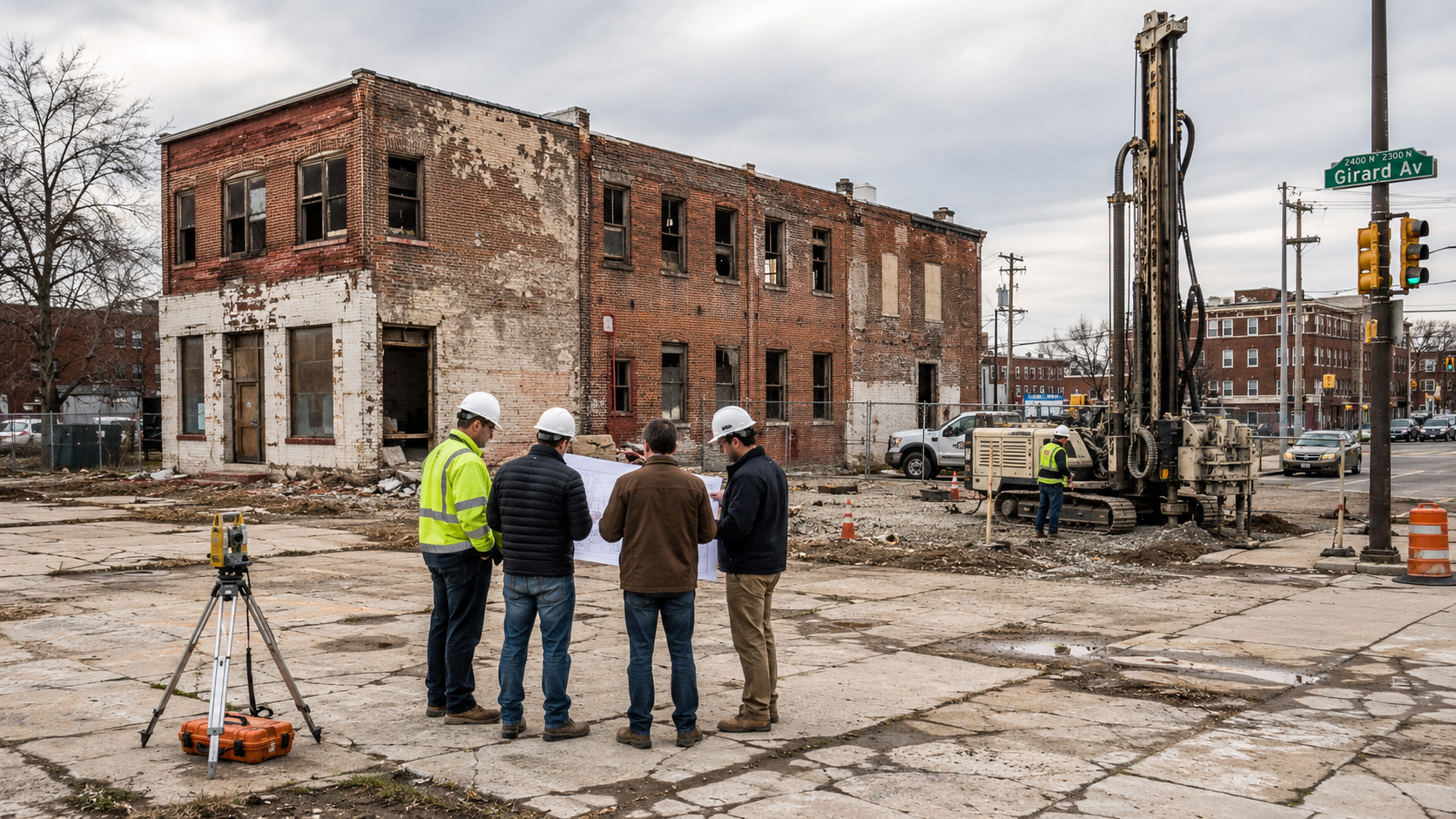
I was recently contacted about a site in Philadelphia.
The owner had purchased a corner lot at a prominent intersection. The site had clearly been developed before. In its current condition, it had a large concrete pad and two dilapidated buildings connected to each other. The owner’s plan was simple. Demolish what is there and build a new multifamily building in its place.
On paper, that sounds straightforward.
In reality, this is exactly the kind of site where differing site conditions can become expensive, disruptive, and contentious.
A recent Lexology article republished a ConsensusDocs article by Curt Martin and Lee Banta of Peckar & Abramson titled “He Chose…Poorly: How Bad DSC Clauses Lead to Project Doom in the Last Crusade of Construction Risk”. The article addresses how differing site conditions clauses can either help manage subsurface risk or create disputes when drafted poorly.
That distinction matters to commercial owners.
A contract clause can allocate risk. It cannot make the risk disappear.
The Slab Is Telling You Something
When I see a concrete pad on a previously developed urban site, I do not see a blank canvas. I see a question that needs to be answered before anyone prices the work.
What is below that slab matters.
There may be old foundations. There may be rubble from a prior building. There may be abandoned utilities, contaminated soil, unsuitable fill, buried tanks, groundwater, or debris that was never properly removed. The current site condition may only be the last visible layer of a much longer history.
This is not unusual in commercial real estate. It is especially common on urban sites that have gone through multiple generations of use.
The mistake is treating those unknowns as the contractor’s problem.
They are first an owner problem because the owner selected the site, controls the pre-design process, and decides how much investigation will be performed before the project is priced.
As I wrote in “Change Orders – How to Plan, Mitigate, and Minimize the Impact of Changes on Your Construction Projects”, “Discovery refers to site testing and surveying that should occur before the start of design and construction.”
That advice applies directly here.
Risk Shifting Is Not Risk Management
Owners often try to solve uncertainty with contract language.
That is understandable. Owners want certainty. They want a price. They want a schedule. They want someone else to carry the unknowns.
But broad risk shifting does not make the unknown condition disappear. It only changes the form of the fight later.
If the owner tells the contractor to accept all subsurface risk without giving bidders reliable information, one of three things usually happens.
The first possibility is that responsible contractors price a large contingency. The owner pays for risk whether the condition exists or not.
The second possibility is that aggressive bidders underprice the risk and plan to fight later. That produces change orders, notices, claims, and strained relationships.
The third possibility is that bidders interpret the risk differently. That creates a distorted bid comparison. The low bid may not be the best bid. It may only be the bid with the most optimistic assumption.
None of these outcomes are good owner outcomes.
This is why the ConsensusDocs article is worth reading. The authors explain that differing site conditions clauses were developed to reduce the gamble around unknown subsurface conditions. Used properly, they create a process for time and cost adjustments when actual conditions differ from what the parties reasonably expected.
Used poorly, they invite conflict.
Pre-Design Is Where This Risk Belongs
This is why I keep coming back to pre-design.
Pre-design is not a ceremonial phase. It is where the owner investigates the site, tests assumptions, develops the program, confirms constraints, and decides what risks are known enough to price.
Skipping that step and trying to transfer subsurface risk to the GC is a recipe for lawsuits, aggravation, conflict, and avoidable cost.
A proper pre-design effort for a site like the Philadelphia lot should include the right level of due diligence. That may include a survey, utility investigation, environmental review, geotechnical borings, limited exploratory demolition, test pits, review of historic records, and coordination with civil and structural engineers.
The specific scope depends on the site. The discipline does not.
Owners do not need to investigate everything. They need to investigate enough to make informed decisions.
In the change order article, I also wrote, “Investing time and money in discovery up front will realize considerable financial, emotional, and schedule benefits for you later.” That is the heart of this issue.
The owner will eventually pay for the unknowns. The only question is when and how.
Incomplete Information Produces Bad Pricing
Differing site conditions are not only a legal issue. They are a procurement issue.
If bidders do not receive clear information, they will fill the gaps with assumptions. Those assumptions will not be consistent. Some bidders will carry money. Some will exclude the risk. Some will bury the qualification in their proposal.
This is how owners end up comparing numbers that are not really comparable.
The same principle applies to drawings and scopes. In “Best Practice – Design Drawings – Why You Should Never Accept Drawings Unless They Are Labelled, ‘Issued for Construction’”, I wrote, “Using partially completed drawings to solicit stipulated sum quotations impart significant financial risks and creates unnecessary tension for all parties.”
Subsurface information works the same way.
When the owner asks for a fixed price without giving bidders a reliable site baseline, the owner is inviting tension into the project before the first shovel hits the ground.
Owner-Side Implications
There are several practical decisions commercial owners should make before moving forward on a site like this.
First, treat prior development as a risk signal. A previously developed site is not automatically bad. But it should trigger a more disciplined due diligence process. Existing slabs, abandoned buildings, filled basements, and undocumented demolition history should not be ignored.
Second, control the investigation before procurement. The owner should decide what site investigations are needed before asking contractors to price the work. Leaving each bidder to conduct its own investigation can create uneven information and inconsistent pricing.
Third, give bidders a clear baseline. The bid documents should state what information bidders may rely on, what assumptions are being made, and how differing conditions will be handled. “Information only” reports are often a source of confusion when the design team relied on the same information.
Fourth, use the contract to allocate risk fairly, not magically. A differing site conditions clause should create a process for notice, evaluation, pricing, schedule impact, and credits where appropriate. It should not be used as a blunt instrument to pretend the contractor controls the ground.
Fifth, budget for discovery. Soil investigations and exploratory work cost money. So do change orders, delays, redesign, and disputes. The difference is that discovery gives the owner better information when decisions are still flexible.
GMP Does Not Cure Unknown Site Conditions
Some owners believe a GMP solves this problem.
It does not.
A GMP can be a useful tool when the scope is mature, the assumptions are documented, and the unknowns are properly carried. But a GMP established too early can give owners a false sense of protection.
In “To GMP or Not to GMP That Is the Question?”, I wrote, “Setting a GMP does not insulate the parties from changes.”
That is true for design changes. It is also true for unknown site conditions when the parties have not done enough work to establish a reliable baseline.
A GMP is not a substitute for pre-design due diligence.
The GOA Perspective
At GOA, we do not play games with this kind of risk.
We are an independent owner-side advisory. Our job is not to help owners push unfair risk downstream so a bid looks better on award day. Our job is to help owners make better decisions before the project becomes harder to control.
That means we do not skip steps.
We do not let contractors assume risks they are not meant to assume.
We do not confuse a tough contract clause with a sound project strategy.
On a site like the Philadelphia example, the right approach is to slow down early so the project can move with more confidence later. That means structuring pre-design correctly. It means defining the due diligence scope. It means coordinating the design, procurement, and contract strategy around the actual risk profile of the site.
Contract form matters, but judgment matters more. In “Best Practices – Standard Form Agreements – Why AIA Contracts May Not Be Right For You?”, I wrote, “Each one is written with a certain perspective and they all have their pros and cons.”
The same is true of differing site conditions clauses.
No standard form replaces the owner’s obligation to understand the project risk.
The Better Owner Decision
The better owner decision is not to make the GC responsible for every unknown below grade.
The better owner decision is to identify what can reasonably be known, disclose it clearly, price the remaining uncertainty intelligently, and write a contract that gives both parties a fair process when actual conditions differ.
That does not make the owner soft.
It makes the owner disciplined.
A commercial owner developing a multifamily building on a previously developed urban lot already has plenty of risk to manage. Entitlements, financing, design, neighborhood concerns, utilities, schedule, escalation, and market conditions are enough.
The ground should not be treated casually.
The project will eventually pay for the unknowns. The owner can pay for investigation early, when the information can shape the project. Or the owner can pay later through change orders, delay claims, redesign, and conflict.
I know which path I would recommend.
Closing
Tell me how you have handled subsurface risk on previously developed sites.
Have you seen owners rely too heavily on contract language instead of investigation?
Have you used differing site conditions clauses in a way that protected both the owner and the contractor?
Tell me your stories.




Leave a Reply